
Sections: Information | Cover | Article Text
Information
- Published by:
- Book and Magazine Collector magazine
- January 1989
- Issue number 58
- Book and Magazine Collector magazine
Cover
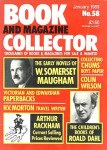
Article Text
Introduction (in Letter From the Editor):
Roald Dahl became a writer more by accident than design. He is, of course, widely known for his very successful Tales of the Unexpected, which seems to be a permanent fixture on television screens all over the world. This month we concentrate on his enormously popular children’s books.
THE CHILDREN’S BOOKS OF ROALD DAHL
KEVIN NUDD LOOKS AT THE LIFE AND WORK OF THE AUTHOR OF ‘CHARLIE AND THE CHOCOLATE FACTORY’
Roald Dahl is easily the best-selling children’s author living today, not just in Britain, but all over the world. His delightfully grotesque stories are devoured by millions of young readers every year and, in a recent bookshop survey, Dahl’s accounted for eight of the ten best-selling titles.
He is adored by his young audience and receives piles of fan mail every day. One commentator remarked that Dahl “is a Pied Piper; the sound of his pipe is subversive and irresistible!” Although his magical tales are full of shocking humour and often revolting detail, they are certainly irresistible to many young readers. It is an apt indicator of the sense of devotion he inspires that in a library copy of George’s Marvellous Medicine I came across recently, the following inscription had been pencilled in by a previous young borrower: “I love Roald Dahl, don’t you?”
Dahl’s writing career has divided neatly into two areas – his adult work, consisting largely of short stories, which were first televised in the 1970s as Tales of the Unexpected, and his books for children. Whilst both sides of his work have been successful, he owes most of his fame (and fortune!) to the latter, and his seventeen stories for children, including such perennial classics as Charlie and the Chocolate Factory, The Twits, Dirty Beasts and James and the Giant Peach, are among the most collected books in the whole field of children’s literature.
BLAKE
All but one of these are beautifully illustrated, many of them by Quentin Blake, and while a first edition of his earliest book can cost as much as £300, the bulk of his output is still very affordable.
Roald Dahl has led an extraordinary life, full of adventure, glamour, heart-breaking tragedies and huge successes. Perhaps it is the richness of his life and experience that has enabled him to create such richly imaginative stories. Certainly it must be true that his unhappy school days were at least partly responsible for some of the rude rollicking tales he wrote many years later, stories in which oppressed kids triumph over tyrannical adults and underdogs always come out on top.
Although both his parents were Norwegian, Dahl was born in Llandaff, South Wales on 13 September, 1916. After losing his one-armed father and elder sister when he was three years old, he was sent to St Peter’s Prep School in Weston-Super-Mare. It was a terrible place, subject to all the usual injustices and cruelties of British public schools. He called it “the greatest torture in the world” and particularly remembers vicious canings from one of the masters, Mr Pople, and the mindless regulation of all parts of the boys’ lives – even going to the lavatory. All that saved St Peter’s from being a complete waste of time was Mrs O’Connor, a kind lady who looked after the boys on Saturday mornings and who instilled in young Roald a love of English literature.
His next school, Repton, was not a great improvement. The frequent beatings by the headmaster, Reverend Godfrey Fisher (who later became Archbishop of Canterbury and crowned Queen Elizabeth II at her coronation), filled Dahl with such hatred that he wrote an account of them in Danny, the Champion of the World. He was a poor pupil.
Although good at sports – he was the school’s heavyweight boxing champion and played on the football, squash and fives teams – he was considered bad at writing. One of his reports stated: “I have never met a boy who so persistently writes the exact opposite of what he means. He seems incapable of marshalling his thoughts on paper.”
He was also something of a misfit, inclined to unreliability and rebelliousness. In 1934 he went on a British Public Schools Exploring Expedition to Newfoundland as the official photographer, during which he led a mutiny against its leader, Commander Murray Levick, a man who had been in the Antarctic with Scott!
After leaving Repton school in 1934, Dahl joined Shell Oil Company and found himself posted to Dar-es-Salaam in Tanganyika (Tanzania), where he learnt Swahili, visited gold mines, drove about in a jeep dressed in khaki shorts with a topee on his head, and caught malaria. It was a thrilling life but it was brought to an abrupt end by the outbreak of the Second World War in 1939.
Dahl decided to join the Royal Air Force because, as he has said, the Navy was too far away and being a soldier would involve too much marching. After a training course which involved a few months of skimming over Kenya in a Tiger Moth so small that his legs came up to his chin, and a month in Iraq, he joined Number 80 Fighter Squadron based in the Western Deserts of Libya. In one raid over the occupying Italian forces he was forced to crash land behind enemy lines, an escapade which left him severely injured. His ancient bi-plane, a Gloster Gladiator, exploded, leaving him badly burnt and with his hips smashed. In later years he had both hips replaced and he now uses one of the originals as a paperweight!
Further action followed in Greece, Syria and Palestine before he was invalided back to England in 1941. Despite his short career as a fighter pilot he had shot down five enemy aircraft. A few months later, he landed himself a ‘plum’ job as Assistant Air Attache at the British Embassy in Washington, and he took up this new position early in 1942. It was a highly sensitive job. In those pre-Pearl Harbour days, America still hadn’t entered the war and the British were particularly keen to know their intentions so Dahl became, in effect, a spy.
CAREER
It was this job which led Dahl into the world of literature, a career he’d never even considered before. After just three days in his new office, a writer doing a series of articles for the Saturday Evening Post invited him to lunch to talk about his experiences as a fighter pilot. The writer was C.S. Forester, the famous author of, among others, the ‘Horatio Hornblower’ stories, and he agreed with Dahl’s suggestion that he provide a written account of his experiences from which Forester would write the article.
Two weeks after sending off his material, Dahl received a letter from Forester which said: “You were meant to give me notes, not a finished story. I’m bowled over. Your piece is marvellous. It is the work of a gifted writer. . . Did you know you were a writer?” In addition Dahl was sent a cheque for 900 dollars and asked by the Post to write more stories for them. His writing career had begun.
WARTIME
Dahl’s first book for children was inspired directly by his wartime experiences. The Gremlins is the story of the mischievous ‘little people’ who tamper with the RAF’s aeroplanes and cause all the breakdowns, faults and crashes that the enemy are usually blamed for. The book was such a success that Walt Disney, whose studios had provided the illustrations for the book, began to make a film of it but, sadly, it was never finished. The popularity of The Gremlins was so great that before long all the airmen in the world knew who their real enemies were, and even President Franklin D. Roosevelt, hearing of them, invited their creator to the White House for a visit – a useful opportunity for Dahl, the spy, to obtain as much intelligence as possible.
The Gremlins was originally serialised in Cosmopolitan magazine in 1942 before being published by the New York firm of Random House in 1943. Collins issued a first English edition a year later. As is so often the case, Dahl’s early works were initially published in America, and the time gap between the U.S. and U.K. appearances were not, as they usually are, just a few days. One of these titles, James and the Giant Peach was published in Britain a full six years after it had first appeared in America; for Charlie and the Chocolate Factory and The Magic Finger the gap was two or three years. Collectors must decide for themselves which edition they prefer. The Gremlins is now extremely rare in either format and last year a worn copy of the Random House edition, a 4to volume with picture boards and the dust-wrapper intact, fetched £240 at auction. The previous year, a first English edition without a dust wrapper was sold for £170. It’s quite likely that both these would now fetch closer to £300 or more in Fine condition.
After the success of The Gremlins, Dahl turned his hand to writing for adults, and he published no children’s books for nearly twenty years. He wrote just one novel and three books of short stories during this time – not a prodigious output, but as most of the stories had originally appeared in American journals like the New Yorker, Harpers magazine, Cosmopolitan and Saturday Evening Post, who paid him up to $3,000 for each story, he only needed to write one or two a year to earn a comfortable living.
BRITAIN
After the war Dahl returned to Britain, but continued to live between here and New York to allow him to consult with his American editors and publishers, and keep in touch with his newly acquired friends. These included Ernest Hemingway (to whom Dahl acknowledges a great debt in influencing his prose style), John O’Hara, Leonard Bernstein and the glamorous actress Patricia Neal whom, he says, he met on 20 October, 1952 at 6.45pm precisely. That particular page from his pocket diary was mounted in a small frame and still stands displayed in his living room.
Dahl and Patricia Neal married in 1953 and had five children, but a series of tragedies caused such a strain on the marriage that they were divorced five years ago. It’s typical of Dahl’s resourcefulness and imagination that at least some good came from those ‘disasters’ as he calls them. In 1960, a freak accident left his son Theo severely brain-damaged and in grave danger of losing his life, but Dahl, refusing to accept defeat, jointly invented a revolutionary valve for drawing off the excess water-on-the-brain. Thea is now alive and thriving thanks to the DWT (Dahl-Wade-Till) valve. In 1962 his daughter Olivia died from a rare complication following a bout of measles, and in 1965 Patricia suffered a rupture of the brain so bad it left her half-paralysed, and unable to talk or even remember the names of her children. It was only due to tremendous courage on her part, and his ruthless determination that she should recover, that she survived, and by 1967 she had begun shooting a new film. One of his helpers during this trying time was Valerie Eaton Griffith who, inspired by Dahl’s determination, founded the Volunteer Stroke Scheme, now a part of the Chest and Heart Association. It now has more than 40 branches with nearly 5,000 members nationwide.
It is quite astonishing that during this blackest period of his life, Dahl was writing two of his best-loved and most widely acclaimed books, James and the Giant Peach and Charlie and the Chocolate Factory. He returned to children’s fiction quite by accident and thanks must go to his own children for the shift. “I used to tell them a different made-up story every night”, he said. “Some of them were pretty rotten but with one or two a child would say, ‘Can we have more of what you told us last night?’ And so I started writing James. I liked it so much I went straight on to Charlie.”
PEACH
James and the Giant Peach was published by Knopf in America in 1961 and by Allen & Unwin in 1967. With its charming illustrations by Nancy Eckholm Burkert it is a wonderfully inventive tale of young James and a peach which grows, and grows, and grows. James travels the world inside the peach accompanied by several giant insects and there is one marvellous scene where the peach runs over James’s nasty aunts. This is a common theme in Dahl’s books; oppressed, imaginative youngsters triumphing over tyrannical adults; often with what some squeamish adults see as vindictive cruelty. But this is the key to Dahl’s success. He understands that children warm to the sort of horrors that make mere adults squirm with unease, and he uses the same theme just as successfully, but never repetitively, in a number of later books, notably George’s Marvellous Medicine and Matilda. Some adults may find his stories objectionable, but Dahl is not writing for them. He is writing for children, and they adore him in large numbers.
Charlie and the Chocolate Factory appeared in America in 1964 and in Britain three years later. It was this book which established him as the superstar of children’s storytelling. Thanks to the film adaptation in 1971 (which, incidentally, he greatly disliked), everybody knows the story of how Charlie Bucket finds the last Gold Ticket in a Whipple-Scrumptious Fudgemallow Delight and so wins a dream tour of Willy Wonka’s magical Chocolate Factory with its underground passages and secret caverns. It is a child’s paradise.
OVERNIGHT
Charlie was by no means an overnight success, though. In its first year only 5,000 copies were sold, but within five years annual sales had reached 125,000. Twenty-five years on, it sells over 100,000 paperback copies every year, and it’s quite likely that even this figure will be surpassed soon. Earlier this year the book was published for the first time in China, with an initial print run of 2 million copies. It will be interesting to see if Charlie sells as many copies as Mao’s Little Red Book!
Already Charlie has established itself as one of the most enduring post-war children’s books and first editions are now rare, but by no means unobtainable. A copy of the American first will cost up to £50 in Fine condition and the British first should be priced at around £20-£30.
The late 1960s and early 1970s saw Dahl consolidate his position as the top living children’s writer with such stories as The Magic Finger (Harper 1966, Allen & Unwin 1968), Fantastic Mr Fox (Knopf 1970, Allen & Unwin 1970) and a sequel to Charlie, Charlie and the Great Glass Elevator (Knopf 1972, Allen & Unwin 1973). During the same period he found time to publish several more adult volumes as well as writing the screenplays for three films; his own Willy Wonka and the Chocolate Factory, Chitty-Chitty-Bang-Bang and the James Bond film, You Only Live Twice.
As with all books for children, a good story is immeasurably enhanced by good accompanying drawings and Roald Dahl has been particularly fortunate in his choice of illustrators. Up to the late 1970s he had used a number of distinguished artists including Joseph Schindelman, Jill Bennett and William Pene Du Bois. In The Enormous Crocodile (1978), however, he teamed up with Quentin Blake, a freelance illustrator who had recently been appointed Head of the Department of Illustration at the Royal College of Art. All but one of Dahl’s subsequent books (the exception being Dirty Beasts, published by Cape in 1983 and illustrated by Rosemary Fawcett) have been made even more appealing by Blake’s gorgeous illustrations. For many people, the partnership of Dahl and Blake has the potential to rank alongside other famous writer/artist teams as illustrious as Lewis Carroll and Sir John Tenniel, and A.A. Milne and E.H. Shepard. It is Blake’s ability to absorb the childish appeal of Dahl’s stories that enables him to create such wonderfully apt drawings.
HIGHLIGHT
Since teaming up with Quentin Blake, Dahl has concentrated almost exclusively on his children’s books. One of the highlights of his recent work must be George’s Marvellous Medicine (Cape, 1981), a wonderful tale of how young George Kranky doses his hideous old grandmother with a medicine made from, among other things, False Teeth Cleanser, paraffin, floor polish, flea powder and five hundred gigantic purple pills “for horses with hoarse throats”. The results, as you might imagine, are bizarre, but no more than the “grizzly old grunion of a Grandma” who spends all day “grousing, grumbling and griping” deserves.
Other highlights from these books are The Twits (1980), The Witches (1983) and Revolting Rhymes (1983), a selection of wickedly comic verse versions of traditional tales. Dahl’s personal favourite is The BFG (1982), which tells the story of a big, friendly, vegetarian giant who, with the help of young Sophie and the Queen of England, pens up all the child-eating giants for ever. All of these books were published by Cape in 4to or 8vo format with picture boards or dust-wrappers and illustrations by Blake, and all are still very reasonably priced at around £10 each in Fine condition.
Despite his success and lively history, Roald Dahl leads a quiet life today. Most of his time is spent at Gipsy House, his beautiful Georgian house in Buckinghamshire where he lives surrounded by his antique furniture and a superb collection of paintings by the likes of Picasso, Matisse and Malevich which he bought from the proceeds of stories for U.S. magazines in the 1950s. Dahl does all his writing in a Willie Wonka-like ‘Inventing Room’, a ramshackle old shed in his garden, warmed by an ancient paraffin heater and by writing whilst sitting wrapped up in an old sleeping bag. He always writes on yellow paper with pencils that have rubbers on their tips. It seems a slightly eccentric beginning for some of the most popular children’s stories of all time! And when he isn’t writing, he’s taking care of his beloved orchids, tending his impressive wine cellar or playing snooker with some local friends.
“Writing for children”, says Dahl, “is much harder than writing for adults. Children don’t have the concentration of adults, and unless you hold them from the first page, they’re going to wander away and watch the teIly or do something else. They only read for fun; you’ve got to hold them.” Roald Dahl is able to keep their attention by never talking down to them and by understanding his audience’s sense of humour. His two most recent children’s yarns, The Giraffe, the Pelly and Me (Cape, 1985) and Matilda (Cape, 1988) are just the latest in a long line of books that have put him miles ahead of any other contemporary children’s writer.
No other children’s writer is as bold, as exciting, as rude or as funny as Roald Dahl. For a writer so extraordinarily successful it is amazing that his first editions are still so cheap and relatively easy to acquire, and the large number of specialist children’s book dealers often list at least one or two of his titles in their regular catalogues. It’s almost certain, though, that prices will go up in future. It won’t be long before a large number of new Dahl collectors will be echoing the sentiments of the young borrower from the library: “Roald Dahl, we love you!”
We would like to thank Emily Smith for her help in supplying us with the illustrations used in this feature.